-
Eduard Masana30/01/2026, 09:30
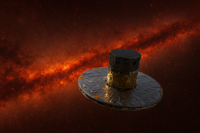
Simulations are a cornerstone in the preparation and design of any space
Go to contribution page
mission. In the case of GaiaNIR, these simulations are critical for estimating the total number of detectable sources, which is expected to significantly exceed the current Gaia catalogue. Such data is essential for refining the mission's observation strategy and finalizing the instrument's technical specifications.
We... -
Pau Ramos (NAOJ)30/01/2026, 09:50
The upcoming Japan Astrometry Satellite Mission for Infrared Exploration (JASMINE) will provide proper motions and parallaxes for the highly obscured and reddened stars in the central-most parts of the Milky Way, which could help disentangle the origin of the different components that co-exist in the inner-most ~200pc. Since optical wavelengths are blocked by dust, JASMINE observes in the near...
Go to contribution page -
Borja Anguiano (Centro de Estudios de Fisica del Cosmos de Aragon (CEFCA))30/01/2026, 10:10
GaiaNIR will not only need advanced instrumentation, but also survey-driven infrastructures able to handle very large and complex data sets. The Javalambre wide-field surveys J-PLUS and J-PAS, led by CEFCA and carried out at the Observatorio Astrofísico de Javalambre (OAJ), are natural precursors in this sense. They already deliver well-calibrated images, catalogues and value-added products...
Go to contribution page -
Chloé Padois (Universitat de Barcelona - ICCUB)30/01/2026, 10:30
The number of detected exoplanets increased significantly in the last decade, finally allowing us to study the exoplanet population from a Galactic point of view. But the detected population is not completely representative of the entire exoplanet population, due to observational biases.
Go to contribution page
Aiming to simulate a realistic Galactic exoplanet population, we combine planetary formation models and...
Choose timezone
Your profile timezone: