Speaker
Description
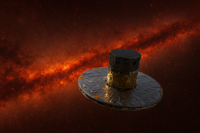
Massive stars play a key role in shaping the structure, dynamics, and evolution of the Galaxy, yet a large fraction of its youngest population remains hidden from optical surveys due to heavy dust extinction. These stars are commonly distributed in groups or clusters, which are often part of star-forming complexes. These regions are characterized by strong infrared emission from the heated interstellar dust, in which their newly born populations of massive stars are embedded. Near-infrared astrometry, as envisioned for a GaiaNIR-like mission, would provide unprecedented access to these obscured environments, enabling accurate distances and proper motions for highly obscured massive stars, young clusters, and OB associations across the Galactic disk and inner regions. In this talk, I highlight key science cases on high-mass stars that uniquely benefit from near-infrared astrometry, and illustrate how a GaiaNIR mission could transform our understanding of massive star formation and early stellar evolution in the dusty Milky Way.