Speaker
Description
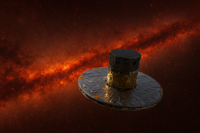
ESA´s Euclid mission was launched from Cape Cañaveral in
Florida in July 2023.
It is a wide-field space telescope with two instrument, the visual
imager (VIS) and the near-infrared imager and slitless spectrograph
(NISP). Euclid is carrying out a 5-year survey of the extragalactic sky
to study the geometry of the Universe.
It has already produced two public data releases, namely the Early
Release Observations (ERO) and the Quick data release 1 (Q1). Deep wide
field multi-color images and catalogs were provided in the the ERO
release, including low-galactic latitude regions in well-known nearby
star-forming regions and very young open clusters. The Q1 release
consisted of a first glimpse of the Euclid Deep Fields that are going to
be observed repeatedly throughout the mission. Preparation of the major
data release number 1 (DR1) is underway as it is scheduled to become
public in the fall of 2026. This presentation will deal with the Euclid
performance and limitations, the current status and future plans,
particularly in the context of synergies with Gaia NIR. Some examples of
big science questions in the realm of Substellar Astrophysics will be
discussed.