Speaker
Description
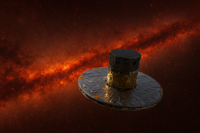
Gaia has transformed our view of the Milky Way, and a near-infrared successor, GaiaNIR, promises an equally profound revolution in our understanding of how stars and planets form. GaiaNIR will provide, for the first time, homogeneous and precise all-sky astrometry down to the lowest-mass end of the initial mass function, crucial for identifying brown dwarfs and free-floating planets members of young star clusters. Estimating the fraction of substellar objects, their multiplicity (through astrometric, photometric, and spectroscopic variability), and their disk fraction (through NIR photometric excess) is crucial for constraining their formation theories. GaiaNIR will also see through the dust-obscured environments where the earliest phases of star formation occur, providing an unprecedented view of deeply embedded protostars, including proto–brown dwarfs for which astrometry is key to assess their nature. NIR spectroscopy, in addition to being decisive in discarding potential background contaminants, will trace accretion (including episodic accretion in young stars) and outflows through key hydrogen and metal line diagnostics. High-precision astrometry and spectroscopy of newborn stars will be crucial for tracing the dynamical evolution of young star clusters, revealing how gas dispersal affects stellar motions and the early evolution of clusters. Together, these capabilities will establish GaiaNIR as a transformative mission for star and planet formation science.