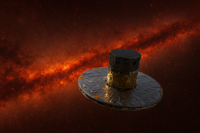
The Gaia mission has revolutionized our understanding of the Solar System by providing unprecedented astrometric and photometric data for small bodies, despite not being originally designed for this purpose. To date, Gaia has delivered high-precision astrometry for over 150,000 asteroids and photometric measurements for tens of thousands of objects, along with reflectance spectra for...
Precise Gaia astrometry and photometry have enabled large-scale studies of unresolved binaries across the Milky Way. However, most existing (spectro-)photometric techniques based solely on these data remain primarily sensitive to high mass-ratio systems (q ≳ 0.6). In a recent pathfinder study we demonstrated that incorporating near- and mid-infrared photometry—such as from 2MASS and...
Massive young clusters, with stellar populations approaching or exceeding ten thousand solar masses, are formidable laboratories to study stellar properties and evolution. On the one hand, they contain so many stars of any given type that they permit statistically robust tests of stellar properties, with samples of the same age and composition. On the other, their upper main sequences are...
Gaia has transformed our view of the Milky Way, and a near-infrared successor, GaiaNIR, promises an equally profound revolution in our understanding of how stars and planets form. GaiaNIR will provide, for the first time, homogeneous and precise all-sky astrometry down to the lowest-mass end of the initial mass function, crucial for identifying brown dwarfs and free-floating planets members of...
I will present how the improvement in astrometry provided by Gaia-NIR for stars in the outermost component of our Galaxy, the stellar halo, will allow us to better constrain the formation history of the Milky Way and the distribution of dark matter. In recent years, several studies have shown that the halo is out of equilibrium and strongly perturbed, in particular due to the infall of the...