Speaker
Description
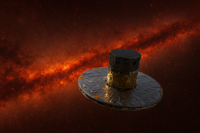
The upcoming Japan Astrometry Satellite Mission for Infrared Exploration (JASMINE) will provide proper motions and parallaxes for the highly obscured and reddened stars in the central-most parts of the Milky Way, which could help disentangle the origin of the different components that co-exist in the inner-most ~200pc. Since optical wavelengths are blocked by dust, JASMINE observes in the near infrared, a band for which high-precision astrometry is just becoming feasible. As such, the data reduction will require extensive testing, assessing the performance of our models of the optics and detectors against different foreseeable scenarios like periodic thermal fluctuations, permanent deformations of the frame, or chromatic effects. We have designed an iterative Least Squares solver that can process billions of observations, millions of parameters, while relying on auto-differentiation to bypass the need to recalculate the analytical derivatives of our changing calibration models. In this contribution, I will present in detail our novel software and show its potential with the results obtained from simulated data. Thanks to its use of auto-differentiation and unique algorithmic structure, it is highly scalable and adaptable, making it very easy to adopt by other missions. The experience we gain deriving NIR astrometry of the crowded Galactic Centre will certainly be, in several aspects, to great utility for Gaia NIR.